Task decomposition
Define exactly where AI is useful and where normal code is safer.
AI AUTOMATION · WORKFLOWS · INTEGRATIONS
AI automation for business processes: classification, extraction, drafting, knowledge workflows and API-connected agents built around measurable tasks.
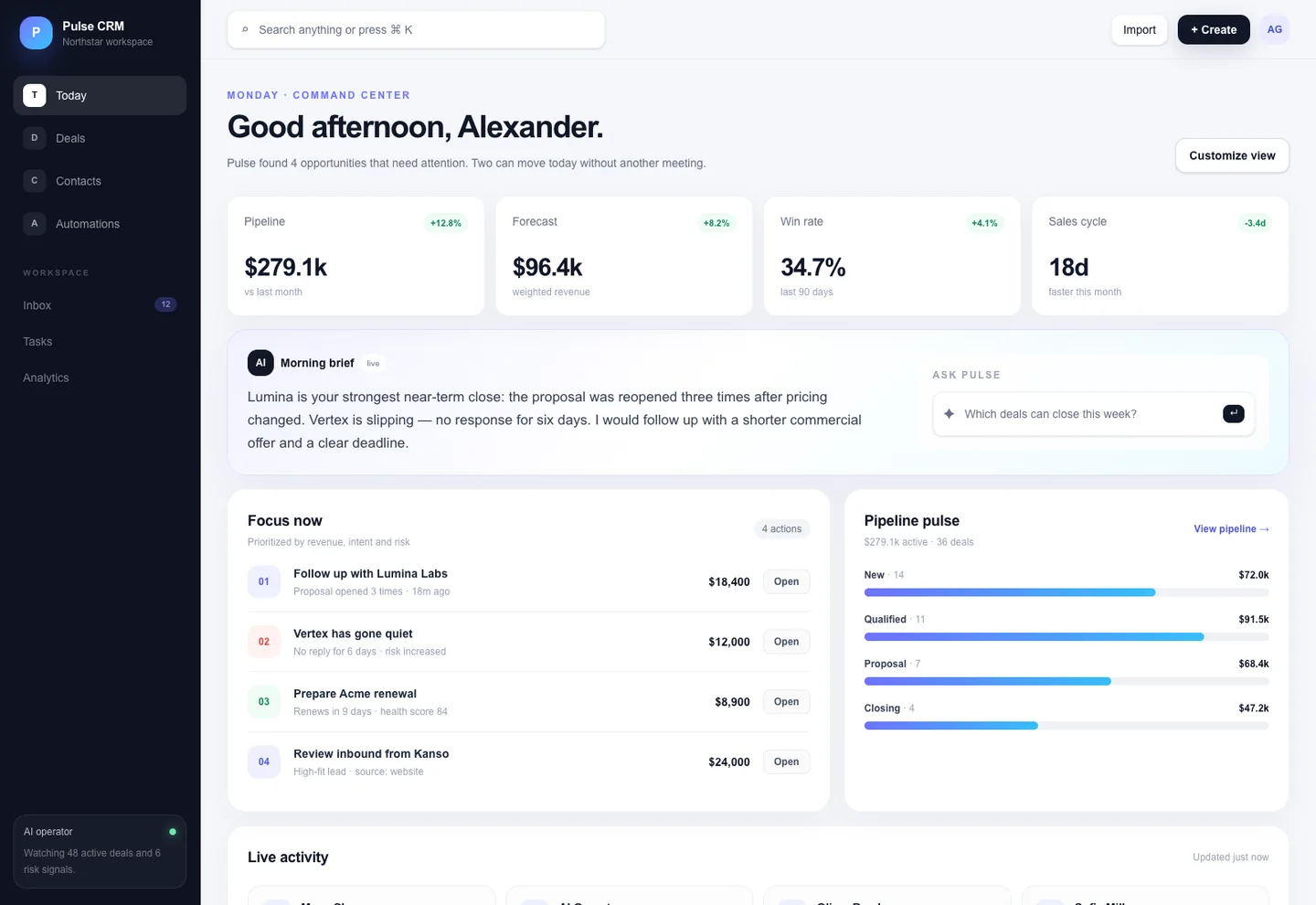
The exact scope follows the product workflow. These are the components that commonly matter for this type of project.
Define exactly where AI is useful and where normal code is safer.
Turn documents, messages or forms into validated structured data.
Categorise requests and trigger the right workflow.
Search and answer against controlled business information.
Generate drafts with context, templates and validation.
Use model output to drive CRM, bots, databases or internal tools.
I do not force every project into one stack. The format should reduce complexity for the user and for the system.
There is ambiguity or unstructured content that rules alone handle poorly.
The process is deterministic and should behave the same every time.
AI interprets the input, code validates it, and integrations execute the action.
Current process, users, inputs, outputs and constraints.
Define the smallest architecture that solves the actual problem.
Implement the end-to-end workflow, integrations and edge states.
Deploy, test real usage and iterate from observed issues.
No. Many automations are better with deterministic logic. AI should be introduced only where it improves the workflow.
Yes. Model steps can be placed inside a bot or an integration workflow and connected to CRM through APIs.
By narrowing the task, using structured formats, validating results and adding deterministic fallback paths.
Yes. A focused AI step is usually easier to measure than a large autonomous system.
YOUR PROJECT IS NEXT
A few sentences about your project are enough to start. A link, design or existing code helps estimate the scope.
@Alexuys ↗alexgtup@gmail.com